 2 hours ago
Updated Wed, March 18, 2026 at 1:49 PM EDT 1 min read
The Federal Reserve is widely expected to keep interest rates unchanged at the end of its two-day policy meeting on Wednesday, but markets will be closely watching for signs of how the war in Iran could affect the Fed's inflation and economic growth outlook.
The recent spike in oil prices, driven by the Middle East conflict, has complicated the Fed's picture, as inflation remains above the central bank's 2% target and the labor market slows.
Traders now expect the Fed won't cut rates until October or December, and the central bank is widely expected to hold rates steady in the 3.5%-3.75% range on Wednesday.
Along with its second policy decision of the year, the Fed will also publish its first Summary of Economic Projections (SEP) for 2026, which will include forecasts from Fed officials on economic growth, inflation, and interest rates for the coming years.
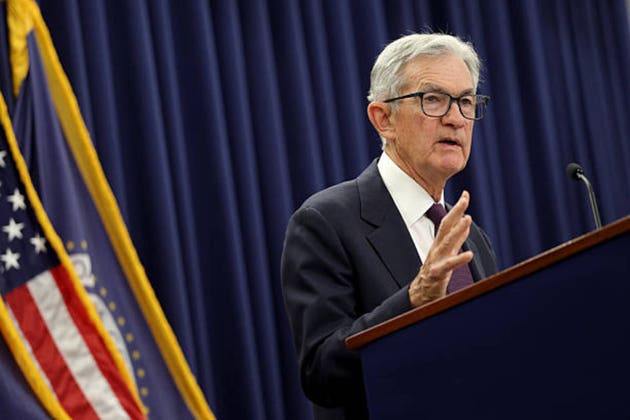
Fed Chair Jerome Powell is expected to underscore that the Fed will remain on hold while it monitors the oil shock during his press conference at 2:30 p.m. ET today, one of the last press conferences of his term.
Here are the latest updates and analysis on the Fed's policy decision.
LIVE 15 updates
Oil prices hold onto gains as Fed decision comes into focus
Roughly 15 minutes out from what is going to be a closely watched Fed decision, even though the market has formed a consensus that rates will remain unchanged, oil prices are holding strong several dollars per barrel above where they opened Wednesday.
Futures on Brent crude (BZ=F), the international benchmark, are up roughly 3% from where they opened at 12 a.m. ET to trade above $104 per barrel. Those on US benchmark WTI crude (CL=F) are up 5% to trade above $97 per barrel.
The big question for the Fed is whether it sees the Middle Eastern energy crisis as a transitory shock to be "looked through" or as a legitimate, long-lasting shock that can meaningfully move up headline inflation, bleed into core inflation, and ultimately stunt growth down the line.

Why the dollar is today’s real Fed trade
Happy Fed Day to all who celebrate.
Today’s FOMC meeting lands on top of a crowded global bet.
BofA’s March Global Fund Manager Survey shows that big institutional investors are the most overweight in emerging market stocks since February 2021 and commodities since April 2022, while still underweight in the US dollar.
That puts the greenback at the center of today’s decision. Powell does not have to move rates to move markets.
If he sounds hawkish and the US dollar index (DX-Y.NYB) pushes back above 100, that could pressure the trades investors have piled into abroad. A softer tone would ease that pressure and give emerging markets stocks and commodities more room.
The level to watch is 100 on the dollar index. A clean break above it tightens the screws. Another rejection keeps the global risk trade alive.
What experts say about the possibility of rate cuts this year
After cutting interest rates three times in 2025, the Fed has held its benchmark rate steady at 3.50% to 3.75% in its first meeting of the year, signaling a more cautious, wait-and-see approach. But how long will the Fed hold rates at the current level?
Yahoo Finance's Ivana Pino explains that while the Fed doesn’t necessarily announce its plans ahead of time, there are a few factors experts look at to forecast potential changes to the federal funds rate. She writes:
Read more here.
Bank of Canada keeps key interest rate at 2.25%, with Iran war and USMCA trade deal in sharp focus
The Bank of Canada kept interest rates steady at 2.25% on Wednesday, as widely expected.
Canada's central bank, like others around the world, is facing a murkier outlook since the war in Iran broke out. Ongoing uncertainty around the renegotiation of the US–Mexico-Canada Agreement also adds to the uncertainty.
"The war in the Middle East has increased volatility in global energy prices and financial markets, and heightened the risks to the global economy," the BoC statement said, as reported by Yahoo Finance's John MacFarlane. "The breadth and duration of the conflict, and hence its economic impacts, are highly uncertain."
Read the latest live updates on the Bank of Canada decision and press conference here.
Inflation surprise: Producer prices rise more than forecast in February, complicating Fed outlook
US producer prices rose more than twice as fast as expected in February, according to data released Wednesday by the Bureau of Labor Statistics (BLS).
The Producer Price Index (PPI) rose 0.7% in February over the previous month, up from January's 0.5% gain and more than double economists' expectations for an increase of 0.3%.
Excluding the more volatile food and energy costs, producer prices advanced by 0.5% over the previous month, outpacing the 0.3% growth economists had predicted but below the previous month's gain of 0.8%.
On a year-over-year basis, headline prices rose by 3.4%, above estimates of 3% and the previous month's 2.9% year-on-year increase. Wholesale prices excluding food and energy rose 3.9% year over year, hotter than the 3.7% estimate and the previous month's 3.6%.
Inflation will be top of mind for Fed officials today as they weigh the surge in energy prices from the Iran war against potential growth risks down the line. Fed officials are widely expected to hold interest rates steady at the conclusion of their policy meeting on Wednesday.
Read more here.
The US economy may be strong — but it's delicate
Yahoo Finance's Hamza Shaban writes in today's Morning Brief newsletter:
Read more here.
Global central bank policymakers cast votes under menace of oil shock
In addition to the Federal Reserve, several other global central banks are in focus this week as they are expected to deliver policy decisions and address the economic fallout from the Middle East war.
"The supply shock is resulting in a market lowering growth expectations and increasing inflation expectations," Capital analyst Kyle Rodda told my colleague Jake Conley. "That's manifesting in doubts about future profitability and the path forward for global interest rates."
Here's an overview of at the major policy decisions unfolding this week:
Reserve Bank of Australia: The RBA raised the cash rate by 25 basis points to 4.1% on Tuesday as policymakers viewed the war in the Middle East as adding to inflation already deemed too high. For more details on the decision, read Yahoo Finance Australia's coverage here.
Bank of Canada: Canada's central bank is expected to continue to keep borrowing costs at 2.25% on Wednesday as the country navigates moderating growth and the renegotiation of the US-Mexico-Canada trade agreement, as well as the global oil shock.
European Central Bank: The ECB is expected to hold interest rates steady on Thursday, March 19, despite concerns of rising eurozone inflation. ECB policymakers are expected to offer assurances that the central bank won't allow another inflation shock like the one experienced in 2022, when Russia invaded Ukraine.
The Bank of England: The BOE is also expected to keep interest rates unchanged at 3.75% on Thursday. Just two weeks ago, the United Kingdom's central bank was expected to deliver its first of two interest rate cuts of the year, but that calculus changed after data released Friday showed economic growth stagnated in January.
Riksbank: Sweden's central bank is expected to hold rates steady at 1.75% on Thursday.
Swiss National Bank: Switzerland's policymakers are expected to keep rates unchanged at 0% on Thursday.
Read more here.
The Fed’s dot plot explained
On Wednesday, the Federal Reserve will print its quarterly economic projections alongside its decision. This summary, also known as the "dot plot", offers insights into what the Fed will do in the short term.
Yahoo Finance's Sarah C. Brady writes:
Learn how to read the Fed's dot plot here.
Why haven’t mortgage rates fallen since the last Federal Reserve decision?
The Federal Reserve signaled in January that it would hold off on raising rates for an undetermined period. That raises the question: What does this mean for mortgage rates?
Yahoo Finance's Hal Bundrick explains that the Federal Reserve and mortgage rates are working on two ends of a timeline. The Fed steers short-term interest rates, and mortgage rates are influenced by long-term bonds.
That means mortgage rates are priced to a longer-term benchmark, such as the 10-year Treasury. The bond market generally reacts to longer-term events, such as inflation, employment, and macroeconomic trends.
He writes:
Read more here.
Tue, March 17, 2026 at 9:32 PM UTC
How are stocks impacted when the Fed doesn’t change interest rates?
US stocks cautiously rebounded for the second day in a row on Tuesday as the Fed's two-day policy meeting began. And while stocks often react to expectations of the Fed's policy actions and to those actions themselves, the markets' focus has largely been on crude oil prices and the outlook for inflation.
As of Tuesday, traders were pricing in a 98.9% chance that the Fed keeps interest rates at the same level tomorrow, according to CME FedWatch. The other 1.1% of traders expect a 25 basis point rate hike — a turn from the sliver of traders betting on a rate cut just a month ago.
The Federal Reserve doesn't directly oversee markets, its actions can affect sentiment and ripple through equities, bonds, and other asset classes. As Yahoo Finance's Catherine Brock points out, investor expectations can trigger stock price swings when those expectations diverge from the Fed’s decision.
Or as David Russell, global head of marketing strategy at trading platform TradeStation, explained, “The Fed’s main impact on the stock market is to confirm or reject expectations about rates and the economy.”
Read more here about how the Fed affects stocks.
Tue, March 17, 2026 at 8:40 PM UTC
Key questions for the Fed on inflation as oil prices remain elevated
The oil shock from the war in the Middle East raises three major questions for the central bank this week: How will the surge in energy prices impact inflation expectations? Will higher oil costs bleed through to core prices? And how will the Fed respond?
Yahoo Finance's Jennifer Schonberger reports:
Read more here.
Tue, March 17, 2026 at 5:29 PM UTC
What the Fed's rate decision means for your money
The federal funds rate influences savings rates, interest charges, and, to a small degree, mortgage rates. Wall Street traders, as measured by federal funds futures trading, put the next rate cut no sooner than October.
Yahoo Finance's Hal Bundrick breaks down how the continuing rate pause may impact deposits, credit, and debt:
Read more here.
Tue, March 17, 2026 at 3:11 PM UTC
FOMC meeting begins as scheduled
The Federal Open Market Committee (FOMC) meeting began at 10:30 a.m. ET as scheduled, a Federal Reserve spokesperson said.
The FOMC, the Federal Reserve's group responsible for setting monetary policy, is meeting for the second time this year. In January, the FOMC voted to hold interest rates steady following three rate cuts last fall. At the meeting, officials said the job market showed “some signs of stabilization” and suggested they would hold for a while to assess economic data before making further adjustments to the federal funds rate.
The FOMC will release its policy decision at 2 p.m. ET on Wednesday after the meeting concludes. Fed Chair Jerome Powell will then give a press conference at 2:30 p.m. ET on Wednesday, which will be livestreamed.
The press conference is expected to be the second-to-last one Powell gives as Fed chair before he steps down in May.
Tue, March 17, 2026 at 2:26 PM UTC
Central banks face policy trap amid Iran war
The war in Iran has put global central banks in an awkward position: Just as inflation pressures were easing, a surge in energy prices has raised inflation risks once again, while policymakers also face the risks of slowing economic growth.
Yahoo Finance's Jake Conley reports:
Read more here.
Tue, March 17, 2026 at 12:43 PM UTC
Oil price spike likely to keep rates on hold but deepen divisions among Fed officials this week
The context for the Federal Reserve's two-day March policy meeting has changed significantly in the past two weeks, as the war in Iran shows little sign of moderating and oil prices remain around $100 per barrel.
Although the central bank is expected to stay the course and keep interest rates unchanged in a range of 3.5% to 3.75%, uncertainty around the duration of the conflict has raised questions about the path of policy for the rest of the year.
As my colleague Jennifer Schonberger notes, the oil shock from the Iran war could deepen divisions within the central bank on the inflation outlook.
She writes that a few weeks ago, the big debate inside the Fed was how far rates are from neutral — a level on the Fed’s benchmark policy rate designed to neither boost nor slow economic growth. Now the picture is changing and will be defined largely by how long the war in Iran lasts and how long high oil prices linger.
Officials will release the quarterly “dot plot” — a graph that charts how many interest rate cuts each Fed member sees for this year and next. But economists say they are giving less weight to the projections, given the uncertainty around the duration and impact of the war.
Read more about what to expect at this March's Fed meeting here.